How Do I Connect Better With My Child?
Connection is not only spending more time together. It is helping your child feel that their Inner World is safe with you.
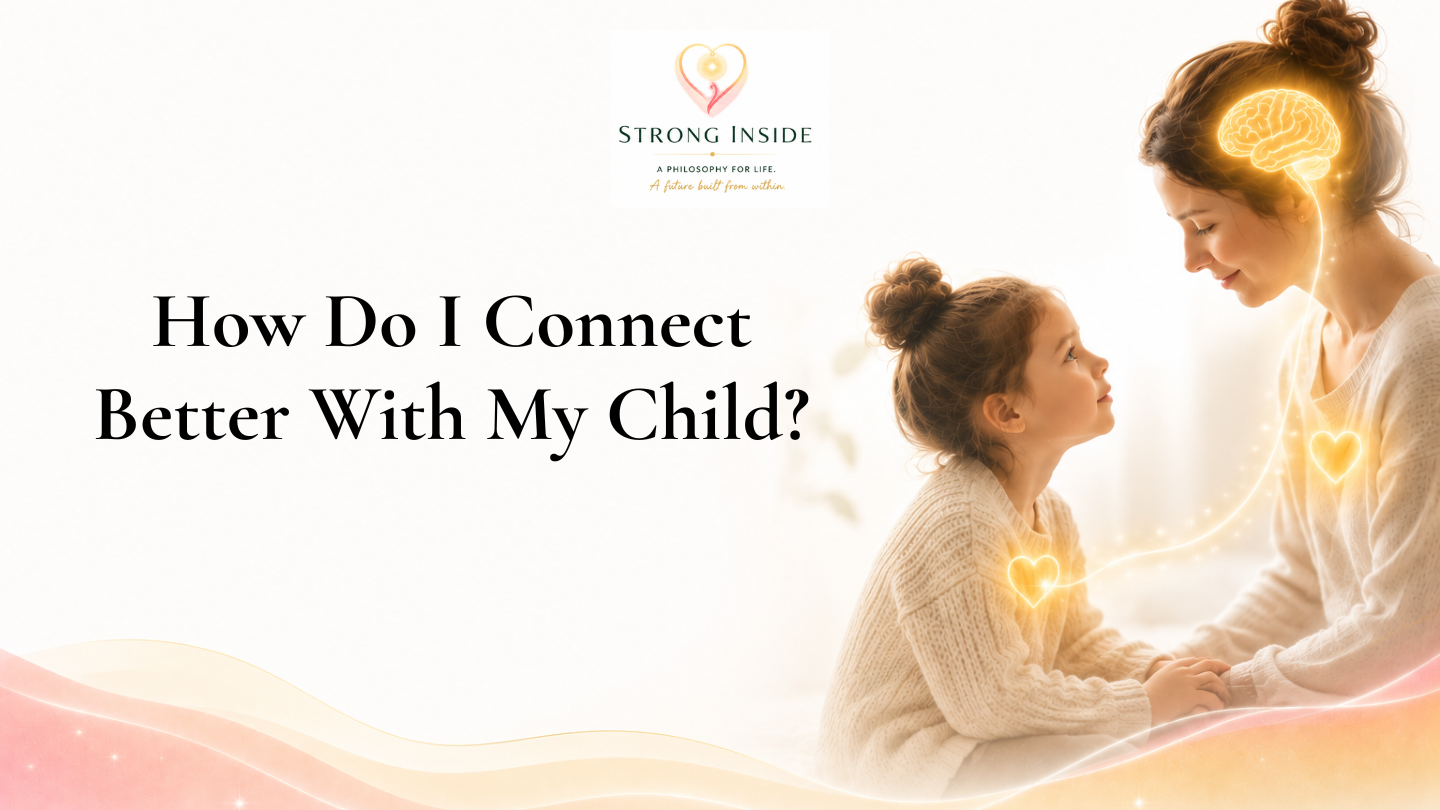
Many parents ask this question quietly.
Sometimes they ask it because their child has started pulling away—answering with one-word sentences, closing the door, avoiding eye contact, or seeming more interested in screens than family. Other times, it's because every single conversation somehow turns into a conflict.
The child is still there, and the love is still there. But the closeness feels incredibly hard to reach. Underneath that distance is a very tender parental ache: "I miss them. I want us to feel close again. I don't want our relationship to be reduced to just routines, instructions, and corrections."
This question matters deeply. Connection isn't just a nice feeling between parent and child; it is the exact place where a child learns what happens to their Inner World when it is seen by another person.
Connection Is More Than Time Together
Many parents assume that connection requires doing more — more outings, more games, more meticulously planned "quality time." While those activities are beautiful, proximity does not automatically equal connection. You can sit in the same car, eat at the same table, and share the exact same routine, yet still feel an invisible wall between you.
True connection happens when a child feels met , not managed. They feel connected when they experience these truths:
- "My parent is genuinely trying to understand what is happening inside me."
- “My big feelings don't make me 'too much' to handle.”
- "My mistakes do not render me unlovable."
- “My Inner World is a safe space to show.”
Disconnection Is Often a Shield
When a child becomes defensive, rolls their eyes, or shuts down, it looks like they are rejecting you. But if we look beneath the behaviour, we often discover they are simply protecting something fragile inside.
They might be protecting shame, fear, disappointment, or the painful feeling of being wrong. If a child has learned that opening up quickly leads to a lecture, a judgment, or a correction, they will naturally create distance to keep themselves safe.
Instead of asking, “Why won't my child talk to me?” we can ask:
- “What might my child be trying to protect right now?”
- “Does my child experience my approach as curious, or as already disappointed?”
- “Are they reading my presence as an attempt to understand, or an attempt to control?”
Your Child Feels Your State Before Your Words
Children feel the adult before they understand the lesson. They register your body language, tone, and underlying energy long before they process your vocabulary.
If you say, "I just want to talk," but your body is vibrating with anxiety or frustration, the child's nervous system will prepare to defend itself. Before a child opens up, their body silently asks: "Am I safe here? Will I be made wrong?"
This is why the first movement of connection starts inside the parent. Before you step into your child's room, check in with your own inner climate:
Am I approaching from a place of pressure, or a place of presence?
Shifting from Judgment to Curiosity
You don't need to understand your child perfectly to connect with them. You just need to be willing to be curious. Judgment shuts down connection because it assumes it already knows the answers. Curiosity opens the door because it assumes there is always more to the story.
| When Judgment Says... | Curiosity Asks... |
| "You are being incredibly rude." | "What happened inside you before those words came out?" |
| "You just don't care about this family." | "Is it possible that caring feels too vulnerable for you right now?" |
| "You are just being difficult." | "What is this behaviour trying to protect or express?" |
This doesn't mean you accept disrespect or let boundaries slide. A child can be deeply understood and still be held accountable. But when curiosity comes first, the behaviour becomes a problem you tackle together, rather than making the child the problem.
Small Moments Build the Bridge
Reconnection rarely happens in one massive, cinematic conversation where the child suddenly pours their heart out. It is built in tiny, everyday increments:
- A slightly softer tone of voice.
- A brief pause before you jump in to correct a mistake.
- Choosing to sit silently next to them on the couch without forcing them to talk.
- Saying, "I think I came in a little too hot before. Let me try that again."
- Noticing, "You got quiet. Did that feel like too much pressure?"
These micro-moments send a profound message to a child's inner world: "My parent notices me. My parent can slow down. My parent stays with me even when I am not easy to be around."
Connection and Boundaries Belong Together
Focusing on connection will not cause you to lose your authority. In fact, connection is the very vehicle that allows your boundaries to be successfully received. A boundary without connection feels like a threat; connection without boundaries feels unstable. Together, they create a safe structure.
- "I see how angry you are, and I will not let you speak to me that way."
- "I know this feels totally unfair to you. The answer is still no."
- "You don't have to talk to me yet, but you do need to stop hurting your sibling."
The Ultimate Safe Place
We don't need to be flawless, unflappable parents. When you inevitably get it wrong—when stress takes over and your voice gets too sharp— repair becomes your highest form of connection.
Taking ownership ( "I'm sorry I reacted so quickly; I want to listen beneath the behavior next time" ) teaches your child that relationships are resilient, mistakes aren't permanent identities, and love is strong enough to look at its own faults.
Ultimately, you connect better not by forcing the door open, but by steadily becoming the kind of safe, curious, and non-shaming presence your child knows they can eventually open up to. From the inside out.