How Do I Help an Anxious Child?
Is anxiety taking over your child’s inner world? Learn how to move beyond reassurance and help your child notice, understand, and lead their inner landscape.
"I don't want to go."
Your child whispers it as they get dressed for school. Or they suddenly complain of a stomach ache before a birthday party. Or bedtime becomes filled with tears because tomorrow feels too frightening to imagine.
As a parent, every instinct inside you wants to make the fear disappear. You rush in to protect them. You try to reason with them, offering comfort and reassurance.
"There’s nothing to be afraid of."
"You'll have so much fun, I promise."
"Everything is going to be okay."
And yet, your words seem to bounce right off them. The worry doesn't shrink. If anything, the more you try to argue it away, the tighter the grip of anxiety becomes.
And suddenly you're carrying two fears. Your child's anxiety... and your own fear that you don't know how to help.
If this sounds familiar, take a deep breath. You haven't failed. You have just been trying to clear away the smoke instead of looking at the fire.
The Smoke vs. The Fire
Most conventional parenting advice treats anxiety like a behavioral problem to be managed or a thought loop to be corrected.
Most parenting advice asks: "How do I change my child's anxious behaviour?"
Strong Inside asks: "What is happening inside my child... and inside me?"
Anxiety is the smoke. The inner world is where the fire begins.
Anxious behaviour—the crying, the avoidance, the clinging—is the smoke. The inner world is where the fire begins.
When anxiety strikes, your child's inner landscape is experiencing a massive storm. Thoughts move through it rapidly, emotions rise like changing weather, and intense body sensations appear without warning.
But anxiety isn't the storm. Feeling lost inside the storm is.
Because they have no map for this storm, they feel completely helpless. They aren't trying to be difficult or manipulative; they are deeply responsive to a terrifying internal environment.
They Borrow Our Presence
When we tell an anxious child, "You're safe, don't worry," we are trying to change their thoughts with our words. But children experience us long before they understand us.
Before children borrow our words... they borrow our calm. Before they borrow our calm... they borrow our presence. Before they borrow our presence... they experience our inner world.
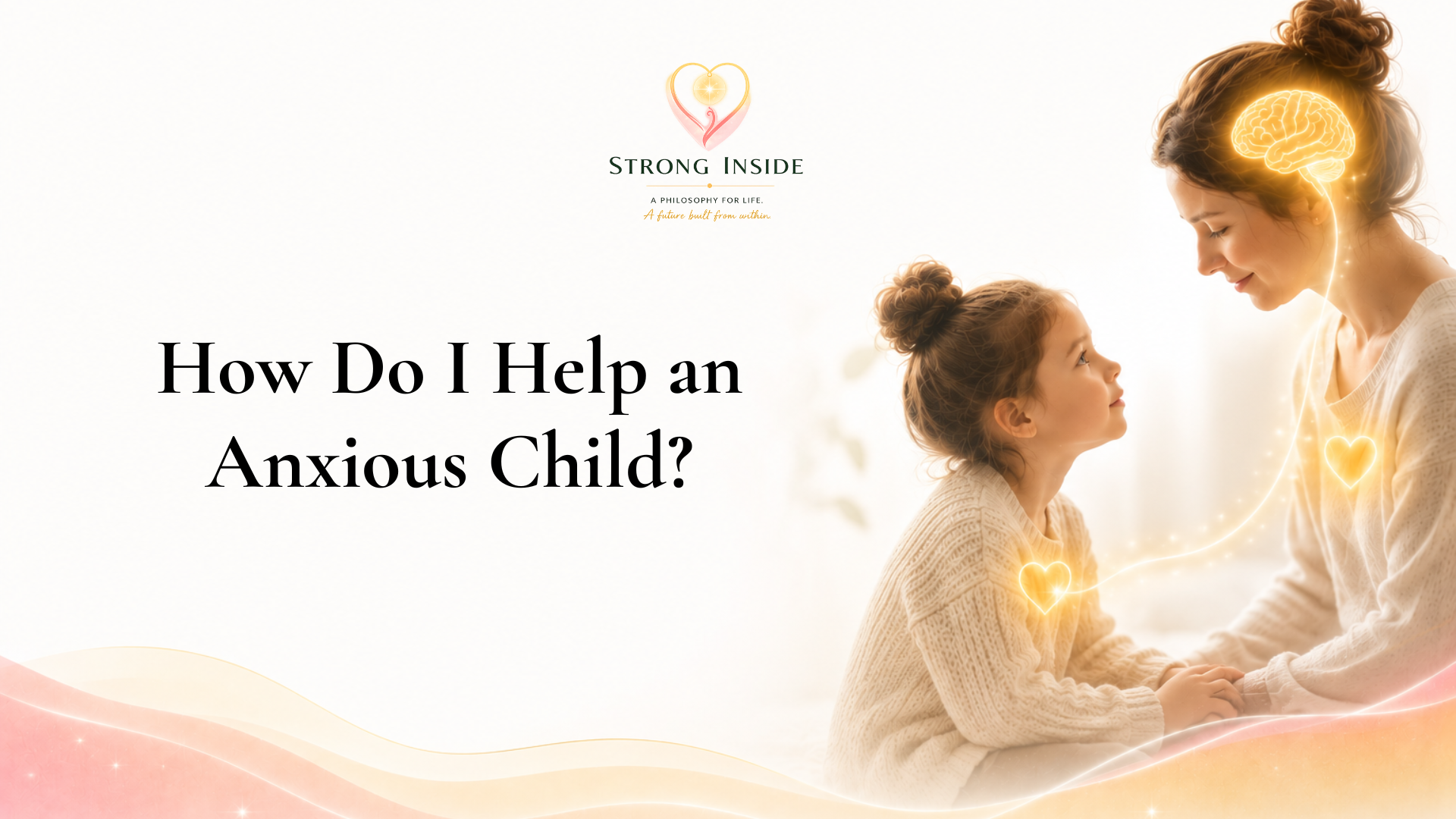
If your inner world is filled with tension, panic, or urgency to "fix" their fear, your child feels that tension before you ever say a word. They scan your presence and look to you for safety. When your child is spinning in an anxious loop, they don't need you to convince them that the storm isn't real. They need you to be the steady anchor that doesn't get swept away by it.
Your calm becomes the place where your child's nervous system can finally rest.
Shifting Your Perspective: Help Them Notice, Understand, and Lead
To guide a child out of the loop of anxiety, we have to move past simply managing the outward behavior. We must help them map out what is happening inside, using three simple steps: Notice, Understand, and Lead.
1. Help them notice the loop
An anxious child completely fuses with their fear. When a worried thought appears, they believe they are the thought. We must help them build a small pocket of space between themselves and the emotion so they can step back as an observer.
Imagine sitting beside your child. Instead of saying, "Don't worry," you gently say, "I can see a very worried thought has arrived today. Let's look at it together." This teaches them that the thought is moving through their landscape, but it is not who they are.
2. Help their body feel safe first
Anxiety is a deeply physical experience. A tight chest, a racing heart, a knot in the stomach—these sensations frighten children more than the thoughts themselves. They cannot think logically when their internal environment is screaming danger.
Before you try to solve the external problem, focus on your own presence. Slow your breathing, soften your posture, and let them coregulate with you. When their body feels safe, the internal noise begins to clear, making room for true understanding.
3. Guide them to lead
Once the somatic storm has quieted, the child can move out of survival mode and reclaim their autonomy. True parenting from inner strength means helping them realize that they hold the steering wheel, even when the weather is unpredictable.
Guide them toward their own insight rather than telling them what to do. Ask simple questions that evoke their inner leader: "The worried thought is telling us to stay home. But you are the leader here. What do you think we should do next? Can we take a tiny step forward together?"
The Path to Self-Trust
This is exactly why I created the Inner Leader Method.
Children can't lead an inner world they don't yet understand. The ILM Tool uses a simple story that speaks the natural language of children, helping them understand their inner world before they have the words to explain it.
When a child learns to notice, understand, and lead their inner landscape, something fundamental shifts. They stop running from their internal weather because they discover the true sequence of growth: Safety, Understanding, Trust, and Leadership.
Why do we help them understand their thoughts, emotions, and body sensations? So they can learn to trust themselves. Because leadership without self-trust isn't leadership—it's performance. The Inner Leader Method isn't simply teaching children to regulate; it's helping them build a relationship with themselves that they can trust for the rest of their lives.
Perhaps your child isn't asking you to remove the storm. Perhaps they're asking you to become the safe place they can return to while the storm passes.
Because children don't become fearless by avoiding difficult emotions. They become confident by discovering they can understand them, carry them, and eventually lead them.
Join our 21-day Inner Leader Method journey and learn how to help your child build the inner abilities they'll use for the rest of their life.