Is My Child Too Sensitive? Understanding Their Inner Landscape
Is your child too sensitive, or do they need help understanding their Inner World? Learn how sensitivity becomes a path to Self-Trust and Inner Leadership.
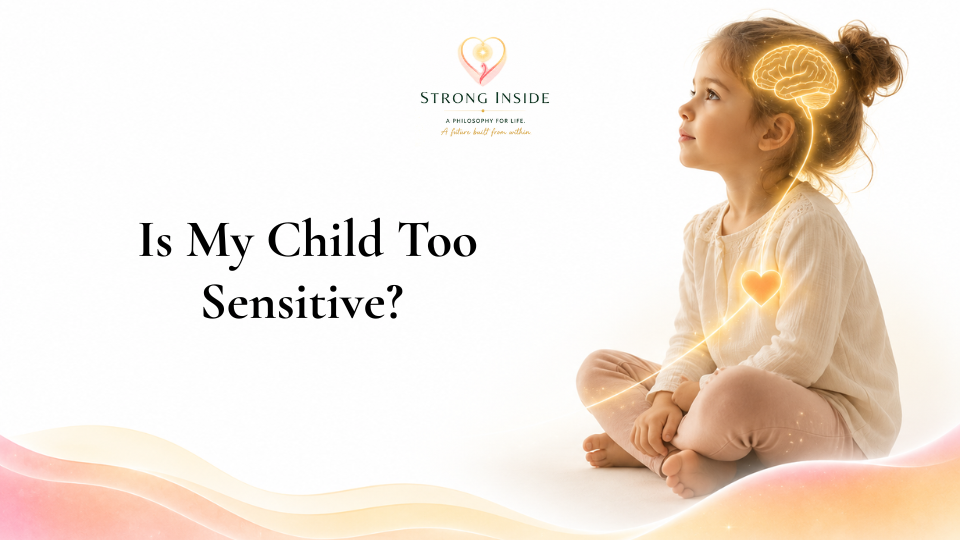
Is My Child Too Sensitive?
One of the questions I often hear from parents is:
“Why is my child so sensitive?”
Maybe your child cries after a small disappointment.
Maybe busy places overwhelm them.
Maybe they take comments deeply to heart.
Maybe they worry about making mistakes, notice every change in tone, or feel emotions with an intensity that seems bigger than the moment itself.
As a parent, it is natural to wonder:
“Are they too sensitive?”
But perhaps that is not the deepest question.
The real question may be:
“Does my child understand what is happening inside them?”
Because children experience their Inner World long before they understand it.
Sensitivity is not a problem on its own.
It is one way a child’s Inner World becomes visible.
The Landscape Without a Map
Imagine your child’s Inner World as a landscape.
Thoughts move through it.
Emotions rise and change like weather.
Body sensations appear without warning.
Memories, fears, wishes and new experiences are constantly finding their place.
Now imagine your child living inside that landscape without a map.
No language.
No understanding.
No way to explain what is happening.
That can feel overwhelming.
Not because your child is “too sensitive,” but because they are experiencing more than they yet know how to understand.
Children are not born knowing how to understand their Inner World.
They learn it.
Just as they learn to speak, read, ride a bicycle or understand the world around them, they also need to learn how to understand the world within them.
Behaviour Is the Message. The Inner World Is the Story.
When a sensitive child cries after losing a game, we often focus on the tears.
When they refuse to join a group, we focus on the behaviour.
When they become angry over something that seems small, we focus on the reaction.
But behaviour is only the message.
The Inner World is the story.
Underneath the behaviour, something is happening inside.
A thought may be saying, “I can’t do this.”
An emotion may feel too big to hold.
A body sensation may feel uncomfortable or frightening.
A meaning may be forming quietly: “I’m not good enough,” “People don’t like me,” or “Something is wrong with me.”
This is why sensitive children often need more than reassurance.
They need help understanding the inner experience behind the reaction.
They are not falling apart because they are weak.
They are showing us that something inside them feels too big, too confusing or too lonely to manage without guidance.
Children Cannot Lead What They Do Not Understand
Adults often ask children to explain why they are upset.
But many children do not yet have the language to explain their Inner World.
They do not think, “My nervous system is activated, and I am creating a meaning from this experience.”
They simply feel the overwhelm.
They feel the tears.
They feel the fear.
They feel the frustration.
They feel the body sensations.
They feel the story their mind is telling them.
And when they cannot explain it, they express it.
This is why behaviour should not be the first place we begin.
At Strong Inside, we begin with a different question:
“What is happening inside?”
Because children cannot lead an Inner World they do not yet understand.
Before they can regulate, they need to recognise.
Before they can make a different choice, they need language.
Before they can trust themselves, they need repeated experiences of understanding themselves.
They Borrow Our Inner Leadership First
Sensitive children do not need fewer emotions.
They need a wiser relationship with their emotions.
Many parents spend years trying to make sensitive children tougher, less emotional or less affected by the world.
But true strength does not grow by feeling less.
It grows by understanding more.
Children first learn this through us.
Before they borrow our words, they borrow our way of being.
They borrow our pace.
Our tone.
Our steadiness.
Our curiosity.
Our ability to stay present when something feels difficult.
This is why the adult’s Inner Leadership matters so deeply.
Your calm is not just a technique.
Your calm becomes part of the environment where your child begins to feel safe enough to understand what is happening inside them.
Your curiosity teaches them not to judge their Inner World.
Your language becomes the beginning of their inner voice.
Over time, what they first experience through you can gradually become something they develop within themselves.
Why the Inner Leader Method Begins With Understanding
This is why the Inner Leader Method does not begin by trying to change a child’s behaviour.
It begins by helping children understand their Inner World.
Through symbolic language and story, children are given a way to recognise thoughts, emotions, body sensations and inner experiences without feeling defined by them.
Instead of becoming the feeling, they begin to notice it.
Instead of believing every thought, they begin to recognise that thoughts are part of their Inner World.
Instead of feeling lost inside the emotional weather, they begin to discover that there is an Inner Leader within them who can observe, understand and gradually choose.
The story is not simply a story.
It becomes a Shared Developmental Language between the child and the adult.
A language that makes the invisible visible.
A language that helps the child say, in their own way:
“Something is happening inside me.”
“I can understand it.”
“I do not have to become it.”
“I can learn to lead it.”
That is where Inner Leadership begins.
Sensitivity Is Not Something to Fix
Perhaps your child is not too sensitive.
Perhaps they are experiencing their Inner World more deeply than they can yet explain.
Perhaps their tears, worries, reactions and overwhelm are not signs that something is wrong with them.
Perhaps they are invitations.
Invitations to slow down.
To look beneath the behaviour.
To ask what meaning is being created.
To help them understand themselves before they judge themselves.
Sensitivity is not something to fix.
It is something to understand, guide and help a child develop a healthy relationship with.
Children do not become strong by feeling less.
They become strong by learning to understand and lead their Inner World.
And that is not only a childhood skill.
It is a life skill.
If you would like to help your child build the inner abilities they will use for the rest of their life, join the21-Day Inner Leader Method Journey and learn how to guide your child from sensitivity into understanding, Self-Trust and Inner Leadership.