What a Pilot Study Reveals About Children's Inner Capacity for Self-Regulation
A pilot study of the Inner Leader Method (ILM) found that children in the programme showed dramatically higher levels of metacognitive distance, self-regulation, and emotional awareness than peers — with 56% at highest developmental level.
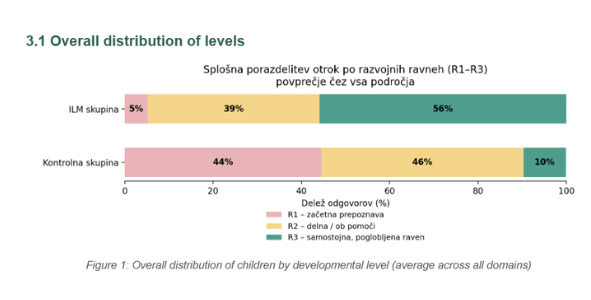
A pilot study of the Inner Leader Method (ILM) found that children who participated in the programme showed dramatically higher levels of metacognitive distance, self-regulation, and emotional awareness than peers — with 56% reaching the highest developmental level vs. just 10% in the comparison group.
When a six-year-old boy was asked a simple question —"Are you the frog, or are you the ruler?"— he answered without hesitation."The ruler."
No explanation needed. No prompting. He understood, using the language he understands for learning this abstract world of emotions, thoughts and sensation. But he understood at a level that most adults would recognise as genuine insight: that he is not his thoughts. He is not his emotions. He is the one who decides what to do with them.
These two responses — separated by a single word but an entire developmental shift — sit at the heart of a recent pilot study evaluating child self-regulation through the Inner Leader Method (ILM), known in Slovenia as the Croaking Frogs (Miselne žabice). The findings are striking, and they have direct implications for educators, parents, and child development specialists alike.
The Study at a Glance
The pilot comparative study involved 40 children aged 5–6:
- Experimental Group: 20 children who had participated in the Mindful Frogs programme for at least one year.
- Comparison Group: 20 children with no exposure to the method.
Each child was individually interviewed using a semi-structured protocol to assess six developmental domains on a three-level scale (R1–R3). This matrix follows Zimmerman’s framework for self-regulation development, moving from basic recognition (R1) through assisted understanding (R2) to independent, self-directed application (R3).
The Numbers That Matter
The data revealed a massive gap between the two groups:
- Children in the ILM group reached the highest level of independent understanding (R3) on 56% of all responses. In the comparison group, that figure was under 10%.
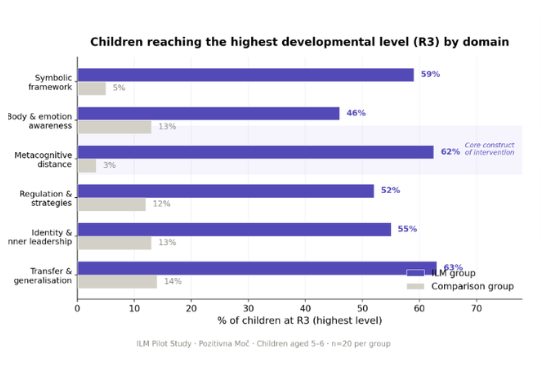
- The most significant difference appeared in metacognitive distance in children (the ability to distinguish between oneself and one's impulses). Here, 62.5% of ILM children reached the highest level, compared to just 3.3% in the comparison group.
This is the definitive difference between a child who is completely swept away by an emotional storm and a child who can observe the storm from a safe distance and choose how to act.
In Their Own Words: What the Children Revealed
While numbers provide the data, the qualitative transcripts show the true depth of emotional regulation for kids when given the right symbolic tools.
1. Intercepting the Impulse
On self-regulation, a five-year-old in the ILM group described catching an aggressive impulse before it manifested physically:
"[The frog] says I have to hit someone, but I catch them and say we're not going to do that."
This exact ability — to notice an impulse, pause, and override it — is one of the most reliable early indicators of developing executive function in early childhood.
2. Creative Adaptations
The program originally introduces a breathing technique called "Hushshshshs" (a prolonged exhale to calm the nervous system). The program supports child development in finding new creative ways to manage inner landscapes. Together with their educator, this group totally embraced "the freezing spray," where they imagine literally freezing an unruly thought-frog.
- 90% of ILM children spontaneously used this self-invented version when demonstrating their calming strategy.
- 95% referenced it when describing a recent real-life situation.
3. Knowing the Limits: Frogs vs. Dinosaurs
One young girl noted that her freezing spray "always works" — but then, without prompting, offered a brilliant distinction:
"One of my frogs turns into a dinosaur. I can't freeze that one with the spray — it's too big."
This shows that the children are not just copying phrases mechanically. They are evaluating their own emotional intensity and acknowledging when a standard coping mechanism isn't enough. In developmental psychology, this is the ultimate hallmark of authentic self-regulation over mere imitation.
4. Real-World Social Transfer
A six-year-old girl beautifully illustrated how this methodology moves from personal calm to social repair:
"Today, when I wanted to hit my friend, I sprayed my thought frogs instead and apologised to her."
The Four Capacities Behind the Data
The study’s six assessment domains map beautifully onto a developmental architecture that the Inner Leader Method calls the Four Inner Capacities:
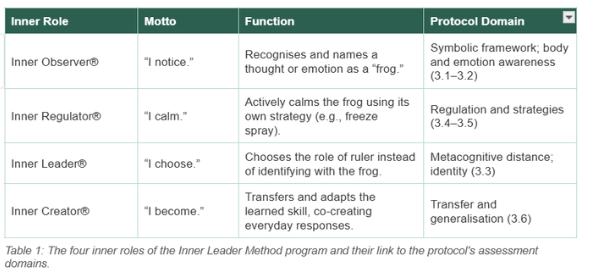
- Inner Observer ("I notice."): The ability to recognise, isolate, and name an internal state using the symbolic framework (frogs vs. the ruler).
- Inner Regulator ("I calm down."): The ability to actively soothe the nervous system using a personally customised strategy, like the freezing spray.
- Inner Leader ("I choose."): The ability to step back from an intense emotion and make an autonomous decision. The boy saying "I am the ruler" embodies this capacity.
- Inner Creator ("I become."): The ability to transfer these skills into real-world relationships, resolving conflicts independently.
Why This Matters for Educators and Parents
Traditional behaviour management models rely heavily on external controls: reward charts, timeouts, consequences, or adult redirection scripts.
This childhood mindfulness study suggests a far more sustainable path is possible. When children are provided with a concrete, accessible symbolic language for their internal world, they don't just learn to sit still or comply out of fear. They develop the internal architecture needed to lead themselves from within.
Perhaps the most touching piece of evidence comes from a six-year-old girl when asked what she would tell the president of her country about the Mindful Frogs method:
"So that everyone in the world would know about thought frogs and could help themselves."
Study Limitations
As a pilot study, the boundaries are clear: it features a small sample size ($N=40$), a single kindergarten setting, and a cross-sectional design. Larger longitudinal studies are required to track these effects over time. However, the data clearly demonstrate that symbolic externalisation and a structured framework can create immediate, measurable improvements in how young children navigate their inner worlds.
See the study HERE.
From Classroom Exercise to Global Need
Ultimately, the numbers from this study validate what the children are telling us in their own words. They don't want to be ruled by their chaotic internal "frogs" any more than we want to be ruled by our adult anxieties. As the six-year-old girl in the study beautifully summarised when asked what she would tell the president:
"So that everyone in the world would know about thought frogs and could help themselves."
She is right. Emotional agency is not a localised luxury or a niche preschool experiment—it is a fundamental human need. And it starts by helping our youngest children realise that they aren't the storm inside their heads; they are the ones capable of guiding it.
Data Source Reference:
Inner Leader Method pilot study in insights by Alex Pin, June 2026.