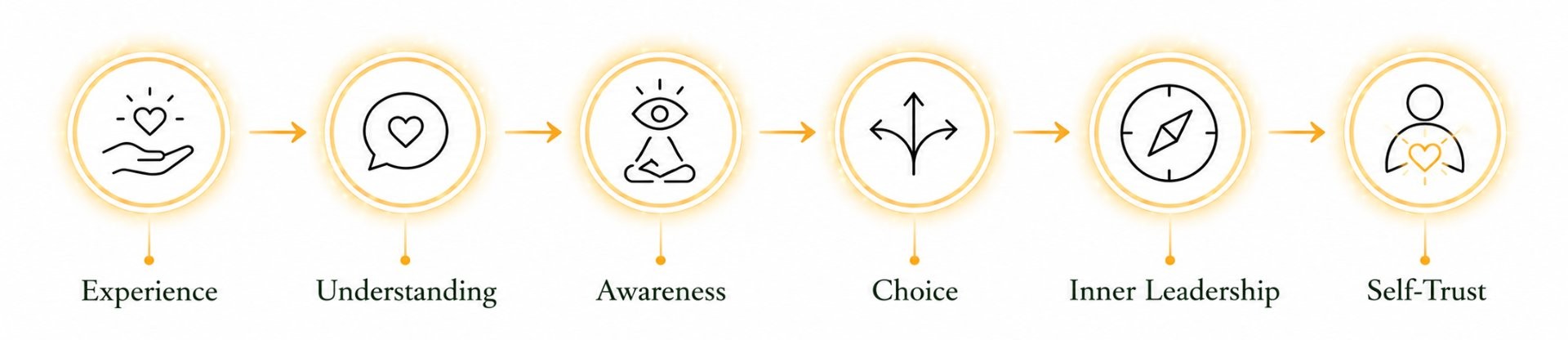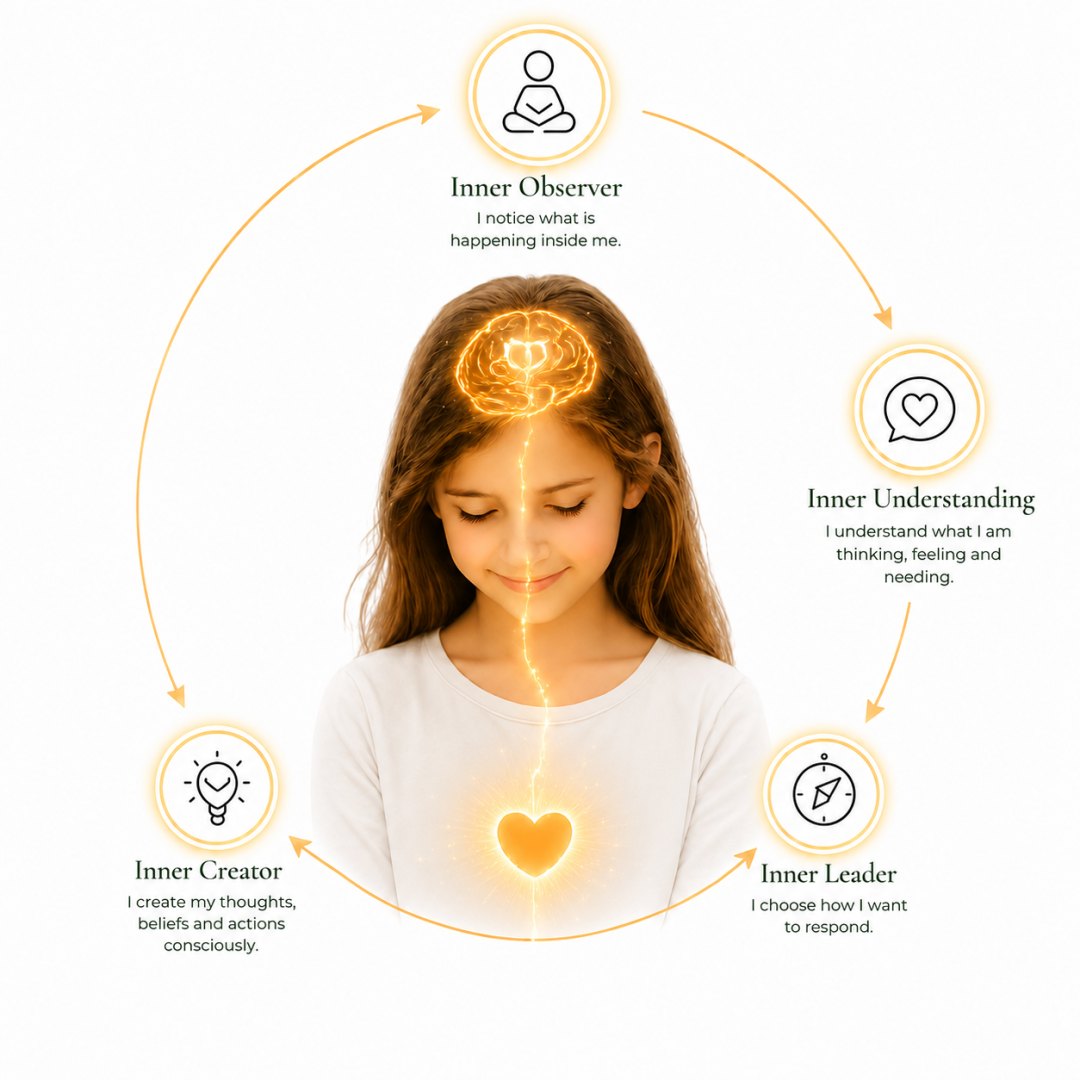
Developing metacognitive awareness and the ability to notice thoughts, emotions, bodily sensations, and impulses.
Developing self-regulation skills that support emotional balance, frustration tolerance, and responsible behaviour.
Developing self-leadership, responsibility, self-efficacy, and the ability to make conscious choices.
Barkley, Lipton, epigenetics: every child is born with unique psychological blueprints. Learn what this means for your parenting and what you're actually shaping.
The limbic system vs. the prefrontal cortex (Siegel). Why children don't "listen"—the reason is not defiance, it's brain development.
Children feel your energy before they notice your expression, and notice your expression before they hear your words. Your inner state speaks louder than anything you say.
Every child has an outer world (behaviour, words, actions) and an inner world (thoughts, emotions, fears, dreams). Learn how to understand both.
After this phase you understand:
Behaviour is not the problem—it is the message. You begin to see the difference between what your child does on the outside and what is happening inside them.
Week 2: The Language and the Story
Children need a language for understanding their inner world. In this phase, you discover the foundations of the Inner Leader Method.
Week 2: Your Most Important Exercise
Learn how to create a personalised story based on your child's unique emotions, challenges, fears, strengths, and experiences.
Weeks 2–3: The First Encounter Discover how to introduce the story, create engagement, and help your child begin exploring their inner world through symbolic language.
Week 3-4: Daily Integration
Learn practical tools, conversations, breathing techniques, reflection activities, and everyday strategies that bring the method to life.
Week 5+: The Long Game
The Inner Leader Method is not a one-time intervention. It becomes a way to understand, guide, and grow alongside your child over time.
Suitable for preschool educators, primary school teachers, school counsellors, special education teachers, SEN specialists, and professionals providing additional support for children.
Educators report a shift from managing behaviour to understanding the thoughts, emotions, and needs behind it. Behaviour becomes valuable information rather than simply a problem to correct.
Participants develop greater self-awareness and emotional regulation, resulting in less impulsive reacting, more conscious responses, and reduced stress in everyday interactions with children.
Educators become more intentional in their communication, using calmer language, a slower pace, and the symbolic language of the Thought Frogs to support connection and understanding.
Children become more capable of recognising emotions, understanding their inner experiences, and using self-regulation strategies before emotions escalate into challenging behaviour.
Educators report calmer group dynamics, stronger relationships, greater trust, and more effective conflict resolution among children.
Children increasingly take responsibility for their actions, demonstrate empathy towards others, and show greater ability to make conscious choices rather than reacting automatically.
Explore the Inner Leader Method, seminar content, implementation process, and upcoming training dates.
EXPLORE THE SEMINAR"This training has been a deeply enriching experience that has transformed the way I work with children. It has strengthened my empathy, patience, trust in children's development, and my ability to focus on solutions rather than problems."
"This programme helped me realise that emotional intelligence is developed not only through dedicated lessons, but through every interaction we have with children. Every response, every conversation, and every calm moment contributes to creating a safe, supportive, and emotionally rich learning environment."
"The experience was incredible. Seeing children with emotional and behavioural challenges, as well as autism, embrace the method and thrive with it has been truly inspiring. What touched me most was witnessing their growing inner strength and confidence."
Alex Pin is a former primary school teacher, author, parenting educator, and creator of the Inner Leader Method (ILM) -Miselne žabice.
Drawing on more than a decade of experience working with children, parents, and educators, she developed a practical and relationship-based approach that helps children understand their inner world, regulate their emotions, and develop self-leadership.
Her work integrates insights from education, developmental psychology, neuroscience, metacognition, and social-emotional learning. Through training programmes, workshops, books, and educational resources, she supports adults in creating environments where children can thrive academically, socially, and emotionally.
Her mission is to help children develop the inner skills behind learning, behaviour, wellbeing, and lifelong success.