How Do I Discipline Without Yelling?
Discipline is not about becoming louder than your child. It is about becoming steady enough to guide them.
Many parents do not want to yell. They don't wake up in the morning thinking, "Today, I want to lose control." They want to be patient and calm and guide their children with love. They want to be the kind of parent their child can trust.
But then real life happens.
The shoes are still not on. The child has ignored the same instruction five times. The sibling fight starts again. The rude tone appears. The clock is moving, the parent is exhausted, and suddenly, the voice rises.
It doesn't happen because the parent doesn't love the child. It happens because something inside the parent has reached its absolute limit.
Yelling Is Not Only a Discipline Problem
When parents ask how to stop yelling, they usually look for better words, clever consequences, or the perfect script. While tools help, the deeper question is: What happens inside the parent before the yelling appears?
Yelling is not just a sound; it is the visible edge of an inner process. Before the voice becomes loud, pressure builds. The body tenses, the breath shallowly shifts, and the mind speeds up with thoughts like:
- “They never listen.”
- “I can’t handle this.”
- “This has to stop right now.”
By the time the yell comes out, the parent's own inner world is already overwhelmed. To change the outcome, we have to look at the pressure building before the explosion.
Discipline Begins Before the Boundary
Most people think discipline begins when the parent says, “Stop,” “No,” or “You've lost screen time.” But discipline actually begins in the adult's emotional state.
The exact same boundary can feel entirely different to a child depending on the state it comes from:
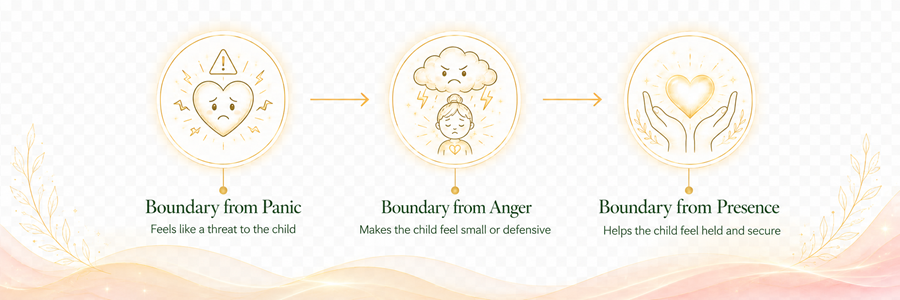
Firmness does not require yelling. Clarity does not require fear. Authority does not require losing connection. A child absolutely needs limits, but the way the limit arrives becomes their learning environment.
Children Feel the Adult Before They Understand the Lesson
When a parent yells, the child may stop what they are doing. But stopping is not the same as understanding.
A child might obey simply because the adult's energy exceeded theirs. They freeze, shut down, or cry. They look like they are listening, but inside, they are just trying to survive the intensity of the moment. This creates quick behaviour modification without deeper development.
| If we use yelling, the child learns: | If we use presence, the child learns: |
| "When someone is louder, I must stop." | "What happened inside me to cause this?" |
| "I need to hide my mistakes." | "How can I repair what I broke?" |
| "Power equals control." | "How do I lead myself next time?" |
True discipline is not control; it is development. It builds a child's inner ability to pause, take responsibility, tolerate frustration, and choose differently next time.
A Boundary Can Be Calm and Still Be Strong
Many parents worry that if they don't yell, their child won't take them seriously. But yelling is often a sign that our own inner world has been hijacked by pressure.
Steadiness, not volume, carries true authority. You can stand firmly enough to guide your child without throwing an adult tantrum:
- "I will not let you hit. The answer is still no."
- “I hear that you are angry, and we are still leaving the park now.”
- "I will help you as soon as your voice is respectful."
- “This behaviour was not okay, and it needs to be repaired.”
What to Do in the Moment Before You Yell
The most critical moment is the tiny window right before the shout happens. It might feel like a tightening in your chest, a heat in your face, or a sudden urge to dominate the room.
This is your gateway to Inner Leadership. When you catch that feeling, take even a single breath to create space and ask yourself:
"Am I responding from presence or pressure? Is my voice trying to guide my child, or is it just releasing my own overwhelm?"
After the Flashpoint: Repair Matters
You will still yell sometimes. The goal is not to become a perfect, robotic parent; it is to become a conscious one. When you lose your patience, repair becomes part of the discipline.
Repair does not mean removing the boundary. It means taking responsibility for how you delivered it.
"I needed to stop you from throwing that, but I did not want to yell. My voice got too loud. The boundary still matters, but I am sorry for the way I said it. I am learning too."
This teaches a child something profound: Adults make mistakes, mistakes can be repaired, and power does not have to hide behind pride.
The Real Goal
Every time we discipline, we shape the child's inner voice. If they frequently hear, "What is wrong with you?" or "You are impossible," they adopt that self-shaming language.
But if they hear, "This behaviour is not okay, but you can repair and learn," they develop an inner voice that separates their identity from their mistakes. They build a voice that says, "I messed up, but I can come back to myself."
Discipline is not the opposite of love. It is love with direction. You don't need to be perfect. You are simply learning to lead yourself, while helping your child learn to lead themselves from the inside out.