Why Children Need More Than Nervous System Regulation
Help children move beyond nervous system regulation by giving them a Shared Developmental Language to understand their Inner World, create healthy meaning and develop Inner Leadership.
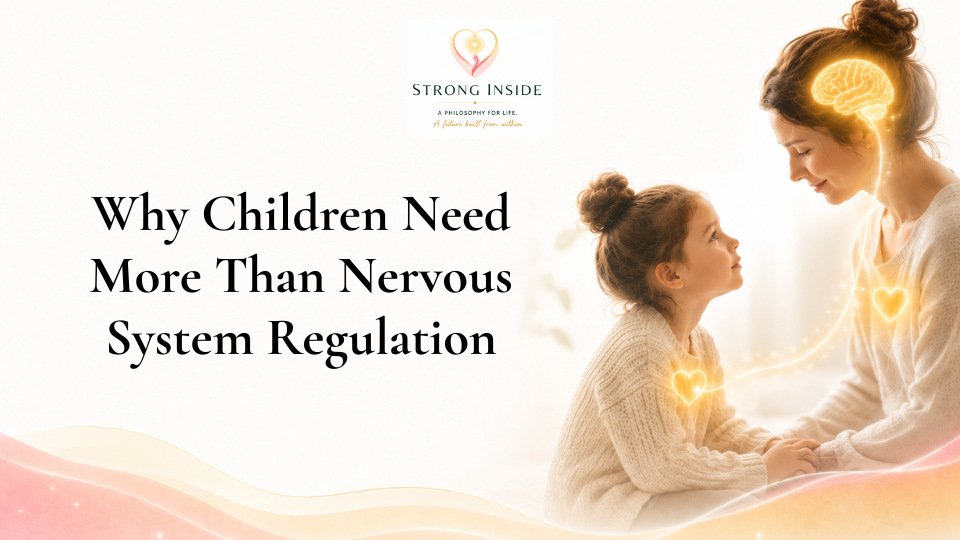
Over the last few years, many parents and educators have begun talking about the nervous system.
And rightly so.
Children are constantly reading the adults around them.
They notice our tone of voice.
Our facial expressions.
Our pace.
Our tension.
Our calm.
Our emotional state.
Long before children understand our words, they experience our presence.
This has been an important shift in how we understand childhood. It reminds us that children are not only listening to what we say. They are feeling the inner world we bring into the relationship.
But there is another question we need to ask.
What happens after the nervous system creates the experience?
Because the nervous system may tell a child:
“This feels safe.”
Or:
“Something doesn’t feel right.”
But it cannot explain why.
It cannot organise the experience.
It cannot help a child understand what is happening inside them.
That requires something else.
It requires language.
Experience Comes First. Understanding Comes Next.
Imagine walking into a country where you do not speak the language.
You hear voices.
You notice expressions.
You sense the atmosphere.
You feel what is happening around you.
You are having an experience.
But you do not understand it.
For many children, this is what their Inner World feels like.
Every day, children experience powerful thoughts, emotions, body sensations, fears, wishes, memories and reactions. They feel disappointment before they can explain disappointment. They feel shame before they can name shame. They feel self-doubt before they understand where it came from.
Without language, these experiences can feel confusing.
And when children cannot understand what is happening inside them, they naturally begin to create their own meaning.
A child is not invited to play and may quietly think:
“Nobody wants me.”
A child makes a mistake and may begin to believe:
“I’m not clever.”
A teacher looks upset and the child may wonder:
“Is it because of me?”
Children do not wait until adulthood to create beliefs.
They begin creating them from the earliest experiences they cannot yet understand.
The Missing Piece Is Meaning
At Strong Inside, we see development as more than behaviour change or emotional regulation.
We see it as meaning-making.
Every experience asks a silent question inside the child:
“What does this mean about me?”
The answer to that question does not always become visible straight away. But over time, repeated meanings begin to form part of the child’s Inner Meaning System.
Meaning becomes belief.
Belief shapes expectation.
Expectation influences behaviour.
Behaviour reinforces identity.
This is why two children can experience the same situation and walk away with completely different beliefs about themselves.
The event is not the only thing shaping the child.
The meaning they create from the event matters deeply.
The nervous system begins the experience.
But meaning shapes the person.
Why Language Changes Everything
This is why children do not only need co-regulation.
They also need a Shared Developmental Language.
They need a way to understand their Inner World before they unconsciously define themselves by it.
Without language, children often become their experience.
“I am angry.”
“I am bad.”
“I am scared.”
“I am not good enough.”
With a Shared Developmental Language, something begins to shift.
“Something inside me feels angry.”
“My thoughts are telling me I can’t do this.”
“My Inner Leader can notice what is happening.”
“This feeling is part of my Inner World, but it is not all of who I am.”
That small shift is deeply important.
The child begins to move from being inside the experience to being able to observe the experience.
And this is where Inner Leadership begins.
Before Children Can Lead Their Inner World, They Need to Understand It
We often ask children to calm down, make better choices, manage their emotions or change their behaviour.
But children cannot lead an Inner World they do not yet understand.
Before regulation, there must be recognition.
Before self-control, there must be self-understanding.
Before conscious choice, there must be language.
A Shared Developmental Language makes the invisible visible. It gives children and adults a way to explore thoughts, emotions, body sensations and inner experiences together.
Instead of asking only, “How do we stop this behaviour?”
We begin asking:
“What is happening inside?”
“What meaning is being created?”
“What belief could grow from this moment?”
“How can I help this child understand themselves before they judge themselves?”
This changes the role of the adult.
The adult is no longer simply correcting behaviour.
The adult becomes a guide.
Someone who helps the child understand their Inner World, recognise the meanings they are creating and slowly develop the Inner Leadership to choose who they want to become.
Every Child Deserves This Language
Every child deserves someone who helps them understand what is happening inside them.
Not someone who gives them a label too quickly.
Not someone who reduces them to their behaviour.
Not someone who only tries to calm the nervous system without helping them understand the experience.
But someone who can gently say:
“Something is happening inside you. Let’s understand it together.”
Because when children understand their Inner World, they begin to trust themselves.
And when they trust themselves, they begin to lead themselves.
That is the beginning of becoming Strong Inside.
If you would like to become that kind of guide:
✨ Parents — Join the 21-Day Raising Inner Strong Children Journeyand learn how to help your child understand their Inner World in everyday life.
✨ Educators — Join the Inner Leader Method Trainingand learn how to create classrooms where understanding comes before correction.