The Method That Transforms Classrooms and Kindergartens From the Inside Out
Why traditional behaviour management falls short — and how the Inner Leader Method builds metacognition, self-regulation, and emotional resilience in children aged 3–10, starting with the adult.
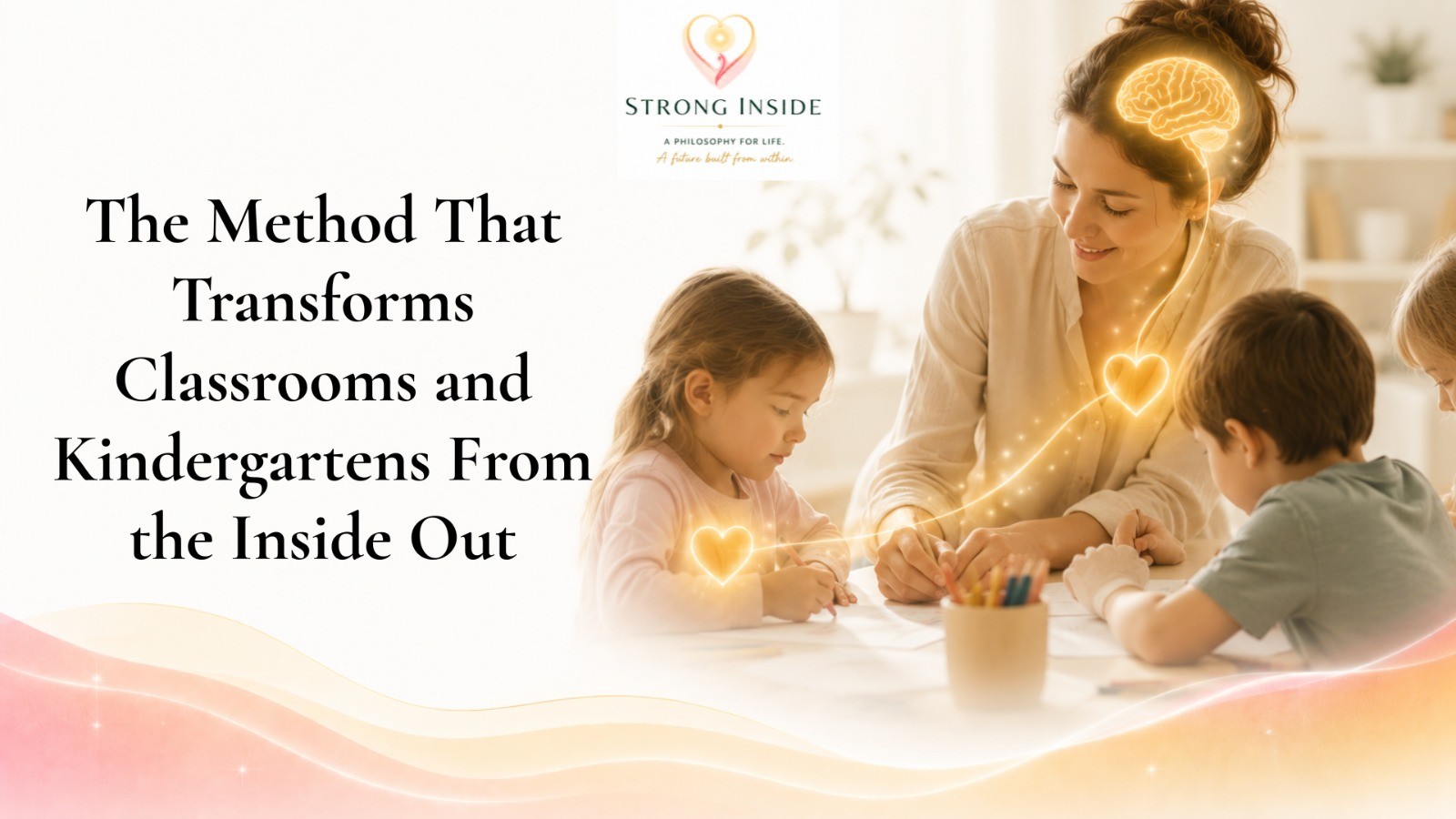
Every early childhood educator and primary school teacher knows the moment. A child erupts — hitting, crying, shutting down. You reach for the familiar script: "Use your words. Take a deep breath. Calm down." Sometimes it works. Most of the time, it doesn't. And quietly, you wonder: What also I can do?
The tools you were given simply weren't designed for how children's brains actually develop.
The Real Struggle in Classrooms and Kindergartens
Across Europe and beyond, educators are facing a growing wave of emotional and behavioural challenges among young children. Anxiety, impulsivity, peer conflict, and difficulty self-regulating are showing up earlier and more intensely than ever before. Teachers report feeling drained — not from the teaching itself, but from the constant emotional firefighting that leaves little room for actual learning.
Traditional approaches tend to focus on managing behaviour from the outside: reward charts, consequences, redirection. These strategies address the surface, but they rarely reach what's happening underneath. And when a child with special needs is in the mix, even the most experienced educator can feel at a loss.
The uncomfortable truth? Most professional development programmes train educators to respond to difficult behaviour. Very few train them to understand and transform it — starting with themselves.
A Different Starting Point: The Inner Leader Method
The Inner Leader Method (ILM) takes a fundamentally different approach to children's emotional development.
Rather than focusing primarily on behaviour management, ILM helps children develop four essential inner capacities that support emotional wellbeing, learning, relationships, and resilience throughout life.
The first capacity is the Inner Observer — the ability to notice thoughts, emotions, body sensations, and impulses without immediately reacting to them. Before children can manage their emotions, they need to become aware of what is happening inside them.
The second capacity is the Inner Regulator — the ability to calm the nervous system, tolerate difficult emotions, and return to balance. Instead of suppressing feelings, children learn how to stay connected to themselves while experiencing them.
The third capacity is the Inner Leader — the ability to make conscious choices. Children begin to understand that they are not their thoughts, emotions, or impulses. They learn that even when they feel angry, frustrated, worried, or disappointed, they still have the power to choose how they respond.
The fourth capacity is the Inner Creator — the ability to generate solutions, adapt to challenges, and find constructive ways forward. Rather than relying solely on adults to solve problems for them, children learn to think creatively and discover their own strategies for navigating difficulties.
To make these inner processes visible and accessible, ILM uses the language of Croaking Frogs®. Frogs represent the thoughts, emotions, impulses, and inner experiences that sometimes take over a child's attention and behaviour.
This simple language creates psychological distance between the child and the experience.
What Makes ILM Different
If you've worked with social-emotional learning programmes before, you might wonder how ILM stands apart. Several things set it apart from conventional approaches:
It starts with the adult, not the child. ILM operates on an "adult-first" principle. Before introducing the method to children, educators go through their own process of nervous system regulation and self-awareness. The reasoning is grounded in neuroscience: a dysregulated adult cannot co-regulate a child. When the teacher is calm, the child's mirror neurons have something steady to mirror.
It reframes behaviour as information. Instead of asking "Why did you do that?" — a question that triggers defensiveness — ILM-trained educators learn to see behaviour as a window into the child's internal state. Curiosity replaces correction.
It uses one story, not a curriculum. There are no binders full of lesson plans. ILM centres on a single, co-created narrative that the child personalises and carries with them. It integrates naturally into everyday moments rather than requiring separate "SEL time."
It builds metacognition, not just compliance. Children don't just learn what to do when upset. They learn to notice their own thinking — to observe a thought before it drives their actions. This is metacognitive awareness, and research shows it is one of the strongest predictors of long-term emotional and academic resilience.
What Educators Experience
Teachers and kindergarten professionals who have trained in ILM consistently report a shift that goes beyond technique. They describe a change in perspective — from trying to fix behaviour to genuinely understanding what drives it.
Practically, they find they spend less energy on reactive interventions. Communication becomes more intentional and less charged. A shared vocabulary between adult and child — the "frog language" — makes it possible to talk about difficult emotions without judgement or blame.
Many educators say the biggest surprise is what happens to them: they become calmer, more patient, and more present. Not because they learned a new trick, but because the method asked them to do their own inner work first.
What Children Gain
In classrooms and kindergarten groups where ILM is practised, educators observe measurable changes over time. Children begin naming their internal states with growing precision. They start proposing their own calming strategies — deep breathing, imagination-based tools, sensory techniques — without adult prompting. Peer conflicts decrease. Empathy increases. The group dynamic shifts from one of constant management to one of genuine collaboration.
For children with special needs, the symbolic framework proves especially valuable. The story meets the child where they are — no reading required, no abstract concepts to grasp. Just a kingdom, some frogs, and the growing realisation that they have more power over their inner world than they thought.
An Invitation
If any of this resonates — if you've felt the gap between what you were trained to do and what the children in front of you actually need — the Inner Leader Method may be worth exploring.
Strong Inside Academy offers a 30-hour experiential training for educators working with children aged 3 to 10, blending in-person and online learning with ongoing peer support and reflective practice.
Join our STRONG INSIDE community and get the information.